Auburn 851 Speedster: The Supercharged American Art Deco Machine
September 19, 2026 · Oldygoldy
The Auburn 851 Speedster Was Designed to Look Fast Standing Still
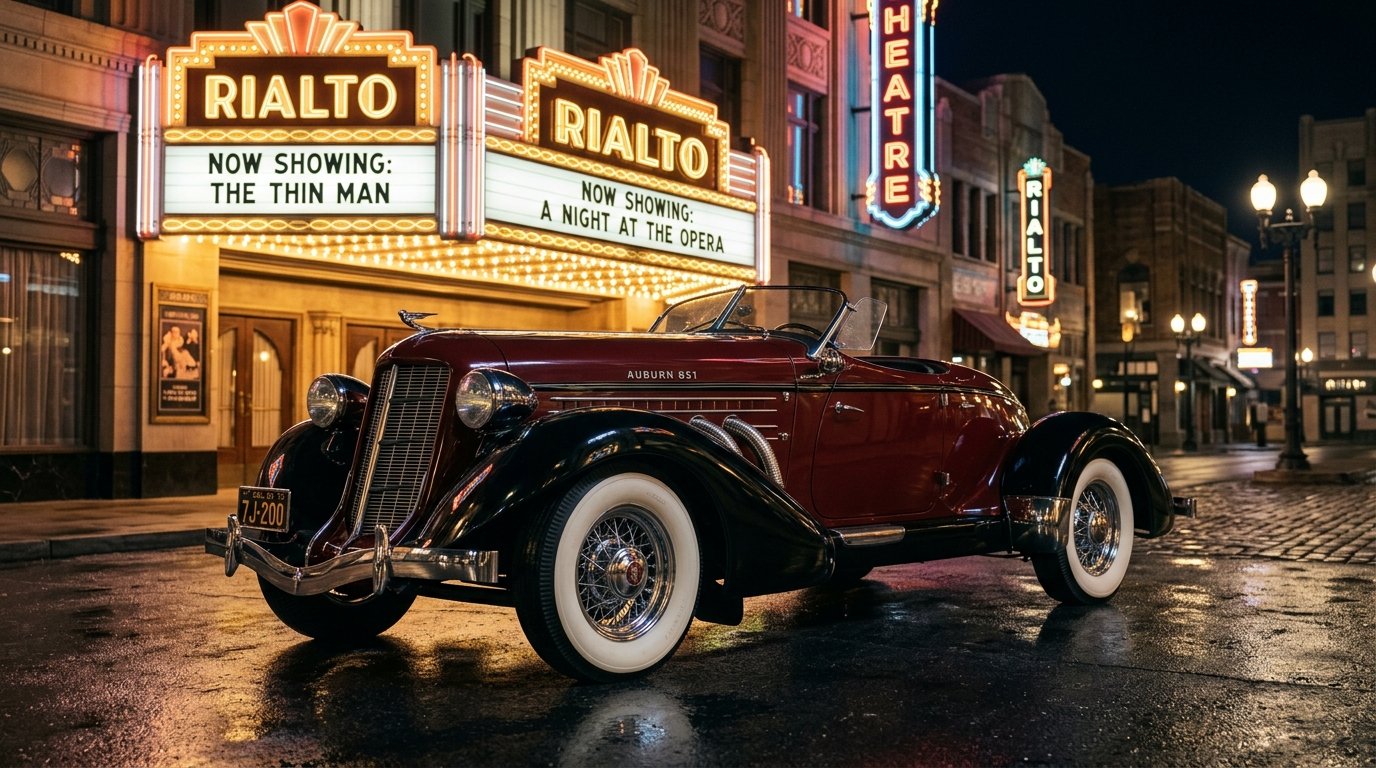
Few American cars of the 1930s express speed as clearly as the Auburn 851 Speedster.
Its long hood, low windshield, sweeping fenders and sharply tapered rear body created a silhouette unlike the formal sedans that dominated American roads.
The most famous feature was the rear.
Rather than ending in a conventional trunk, the body tapered into a shape resembling the stern of a boat.
This gave rise to the popular description boattail speedster.
The design was dramatic, but the Auburn was not merely a styling exercise.
Supercharged versions offered genuine high-performance capability for their era.
Auburn and the Cord Automobile Empire
Auburn was part of the group of companies associated with businessman E. L. Cord.
The broader automotive empire also included Cord and Duesenberg.
These marques occupied different positions.
Duesenberg represented extreme American luxury and performance.
Cord explored advanced engineering and futuristic design.
Auburn attempted to offer dramatic styling and impressive specifications at prices below the most exclusive luxury marques.
This strategy produced some extraordinary automobiles.
The 851 Speedster became one of the most memorable.
Gordon Buehrig and the Speedster Design
Designer Gordon Buehrig is closely associated with some of the most important American cars of the 1930s.
The Auburn Speedster benefited from that design philosophy.
The car’s body appears to move even while parked.
A long hood visually emphasizes the engine.
The windshield is relatively small and sharply angled.
The rear tapers dramatically.
Chrome details reinforce the horizontal movement of the design.
Unlike boxier automobiles from earlier periods, the Auburn seems shaped by airflow.
This made it particularly compatible with the Art Deco aesthetic that influenced architecture, trains, appliances and industrial design during the period.
The Supercharged Straight-Eight
The Auburn 851 used a straight-eight engine, with supercharged versions providing significantly stronger performance.
The supercharger forced additional air into the engine.
More air allowed more fuel to be burned, increasing power.
Externally, the supercharged cars could be identified by dramatic exhaust pipes emerging from the side of the engine compartment.
These exposed pipes became one of the car’s signature visual features.
The result was an automobile that visually advertised its mechanical capability.
The supercharged Speedster was not trying to look discreet.
Its entire personality was about speed.
The Famous Speed Certification
One unusual part of Auburn Speedster history involved speed certification.
Cars were associated with plaques indicating that the vehicle had been tested to exceed a significant speed threshold.
Racing driver Ab Jenkins became closely connected with Auburn’s high-speed image.
Jenkins was famous for long-distance speed and endurance records, and his association gave Auburn useful credibility.
During the 1930s, a production car capable of exceeding 100 mph was remarkable.
Today, inexpensive modern automobiles can reach similar speeds.
But historical context matters.
Road surfaces, tires, brakes and suspension technology were far less advanced.
Achieving 100 mph was a serious engineering accomplishment.
What Was It Like to Drive?
The Auburn Speedster combined large-car proportions with strong engine performance.
Unlike a lightweight European sports car, it delivered speed through torque and displacement.
The driver sat behind a very long hood.
Steering required physical input, especially at lower speeds.
Braking distances were much longer than in modern cars.
However, once moving, the car offered the kind of relaxed high-speed performance that became characteristic of powerful American automobiles.
The driving experience was theatrical.
The visible hood, external exhaust pipes and dramatic seating position constantly reminded the driver that this was not an ordinary sedan.
Why Was Auburn Short-Lived?
Despite producing memorable cars, Auburn struggled financially during the difficult economic conditions of the 1930s.
The company competed in a complicated market.
Luxury-car buyers had become fewer after the Great Depression, while mainstream manufacturers were producing increasingly capable cars at lower prices.
Eventually Auburn automobile production ended.
That short production history contributes to the company’s mystique today.
Instead of evolving through decades like Ford or Chevrolet, Auburn became strongly associated with a specific historical moment.
Why the Auburn 851 Speedster Matters
The Auburn 851 Speedster represents one of the strongest expressions of American Art Deco automotive design.
It combined genuine supercharged performance with dramatic styling.
It also belonged to an extraordinary family of marques that included Cord and Duesenberg.
Studying the Auburn therefore helps explain the diversity of American luxury cars before World War II.
Not every American performance vehicle was a muscle car.
Decades before the muscle-car era, manufacturers were already experimenting with superchargers, aerodynamic bodies and high-speed touring.
The 851 Speedster is one of the most beautiful surviving examples of that philosophy.
FAQ
What engine did the Auburn 851 Speedster use?
The Auburn 851 used a straight-eight engine, with famous versions equipped with a supercharger for additional performance.
Why is it called a boattail Speedster?
Its rear body tapers into a shape resembling the stern of a boat.
Who designed the Auburn Speedster?
Gordon Buehrig is strongly associated with the celebrated Auburn Speedster design.
Was the Auburn 851 fast?
Supercharged Speedsters were associated with speeds exceeding 100 mph, an exceptional figure for a production automobile in the mid-1930s.