Maserati 300S: The 1950s Racing Machine Built for the World’s Toughest Sports-Car Events
September 20, 2026 · Oldygoldy
Maserati 300S: Built When Sports Cars Were Truly Dangerous
The Maserati 300S belongs to one of the most romantic and dangerous periods in motorsport history.
During the 1950s, sports-car racing took place on fast circuits, mountain roads and public-road courses with very little of the safety infrastructure seen today.
Drivers competed for hours in lightweight machines with powerful engines, narrow tires and minimal protection.
Maserati was one of the manufacturers at the center of this world.
The 300S was created as a serious competition car designed to challenge machines from manufacturers such as Ferrari and Jaguar.
Its formula was relatively straightforward: low weight, strong engine performance, aerodynamic bodywork and a chassis engineered specifically for racing.
The 3.0-Liter Straight-Six
At the center of the 300S was an approximately 3.0-liter inline six-cylinder engine.
The engine used sophisticated racing technology for its time and produced output in the region expected from a serious international sports-racing machine.
But horsepower alone does not explain the car.
The 300S weighed far less than a luxury road automobile.
That meant every horsepower had less mass to accelerate.
A lightweight vehicle also places less demand on brakes and tires.
These principles remain fundamental in motorsport today.
Instead of solving every performance problem by adding more power, engineers reduce weight.
The Maserati 300S was built around this relationship between power and mass.
Beautiful Because It Needed to Be Efficient
The 300S is widely admired for its appearance.
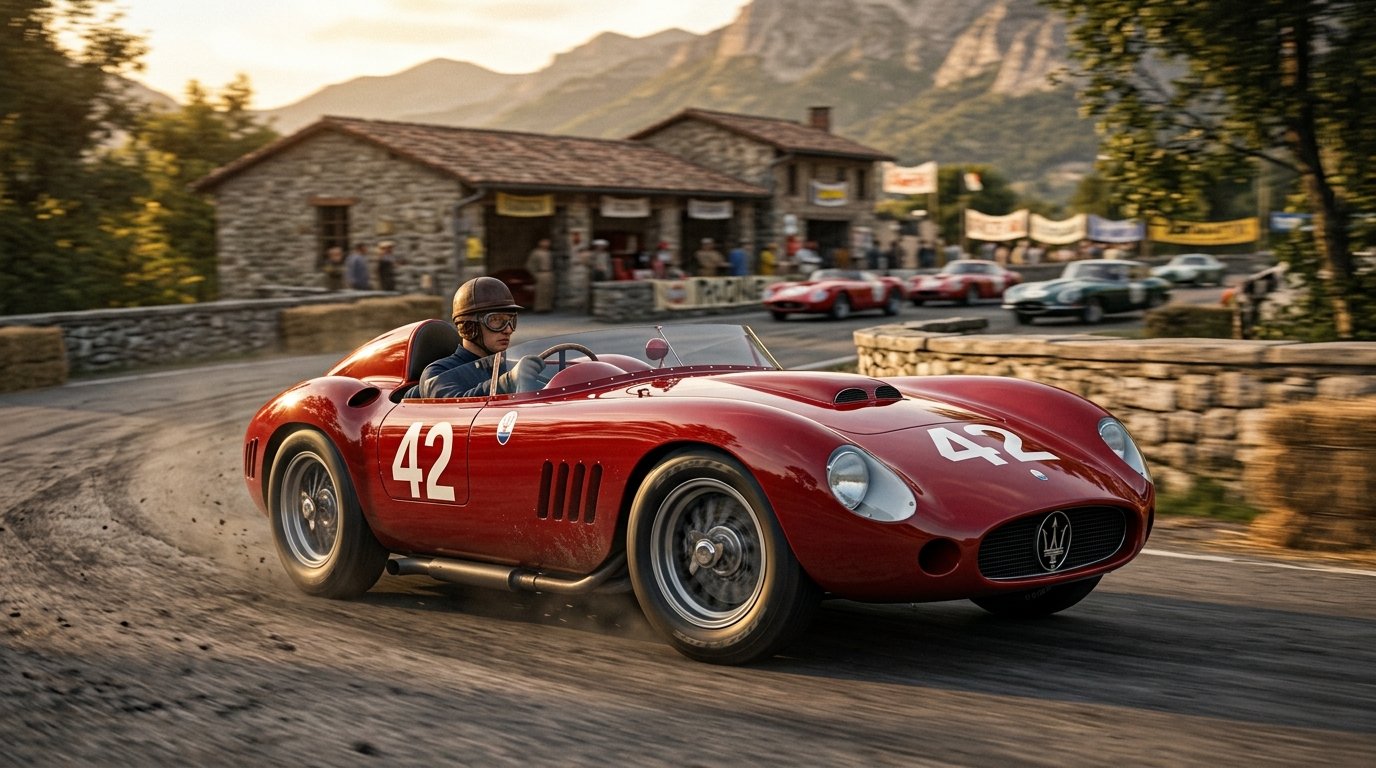
Its body is low and smooth.
The nose is rounded around Maserati’s distinctive grille.
The front fenders rise gently around the wheels before flowing toward the open cockpit.
Behind the driver, the body tapers toward the rear.
This beauty was closely connected to function.
Race cars needed to move efficiently through the air.
Every unnecessary shape could create aerodynamic drag.
Designers therefore created clean surfaces and low frontal areas.
The result was an automobile that looked elegant because efficiency naturally produced elegant proportions.
What Racing Was Like in the 1950s
Modern motorsport spectators are accustomed to substantial barriers, advanced helmets, fire-resistant clothing, medical teams and heavily engineered crash structures.
A driver in a 300S lived in a very different environment.
The cockpit was open.
Protection around the driver’s head and body was limited.
Circuits could run close to buildings, trees, spectators or roadside objects.
Mechanical reliability was also less predictable.
Drivers needed to understand their cars.
They listened for changes in engine sound.
They monitored gauges.
They adjusted their driving to protect brakes, tires and mechanical components.
Winning endurance races required mechanical sympathy as well as speed.
Maserati Versus Ferrari
Italian motorsport during the 1950s was intensely competitive.
Ferrari was expanding rapidly and earning success across multiple racing categories.
Maserati had enormous engineering experience but operated with fewer financial resources.
The 300S therefore became one of Maserati’s most important weapons in international sports-car competition.
Drivers used the car in events around the world.
The objective was not simply winning trophies.
Motorsport served as a demonstration of engineering credibility.
Success could improve the entire brand’s reputation.
For a manufacturer such as Maserati, racing was part of its identity.
The Experience of Driving a 300S
A genuine Maserati 300S is completely unlike a modern sports car.
The driver sits behind a large steering wheel in an exposed cockpit.
The long hood stretches forward.
The engine dominates the experience.
There is little insulation between mechanical components and driver.
The gearbox requires deliberate shifts.
The brakes require judgment.
The tires offer far less grip than modern competition tires.
At high speed, the driver must continuously balance the car using steering, throttle and braking inputs.
Nothing happens automatically.
That directness helps explain why historic racing cars create such strong emotional reactions.
The driver is not simply operating the car.
The driver is participating in every mechanical process.
Why Original Racing History Matters
When evaluating historic competition cars, model name alone is not enough.
Individual chassis history matters enormously.
Collectors ask questions such as:
Did the car race during the period?
Which driver used it?
Which events did it enter?
Was the original engine retained?
Was the chassis damaged or replaced?
What restoration work has been performed?
These details can change the historical importance of two otherwise similar automobiles.
A 300S with documented competition history is not merely an old Maserati.
It is a surviving artifact from specific motorsport events.
Why the Maserati 300S Still Matters
The 300S represents Maserati during an era when the company was known primarily through racing.
Before luxury SUVs and modern digital dashboards, Maserati’s identity came from lightweight machines driven at extreme speeds by professional racers.
The 300S captures that identity exceptionally well.
Its engineering is purposeful.
Its design is beautiful without unnecessary decoration.
Its cockpit reveals exactly what it was built to do.
For enthusiasts interested in understanding the origins of Maserati’s sporting reputation, the 300S is therefore essential.
It tells a story not simply about one racing car but about an era when manufacturers proved themselves through some of the most demanding motorsport events in the world.
FAQ
What engine does the Maserati 300S use?
The Maserati 300S uses an approximately 3.0-liter inline six-cylinder racing engine.
Was the Maserati 300S a road car?
No. The 300S was primarily developed as a competition sports-racing car.
When was the Maserati 300S raced?
The model competed internationally during the 1950s.
Why is the Maserati 300S important?
It represents an important period in Maserati’s sports-car racing history and combines lightweight engineering, aerodynamic design and international competition heritage.