Ford GT40: How America Built a Le Mans Winner
September 24, 2026 · Oldygoldy
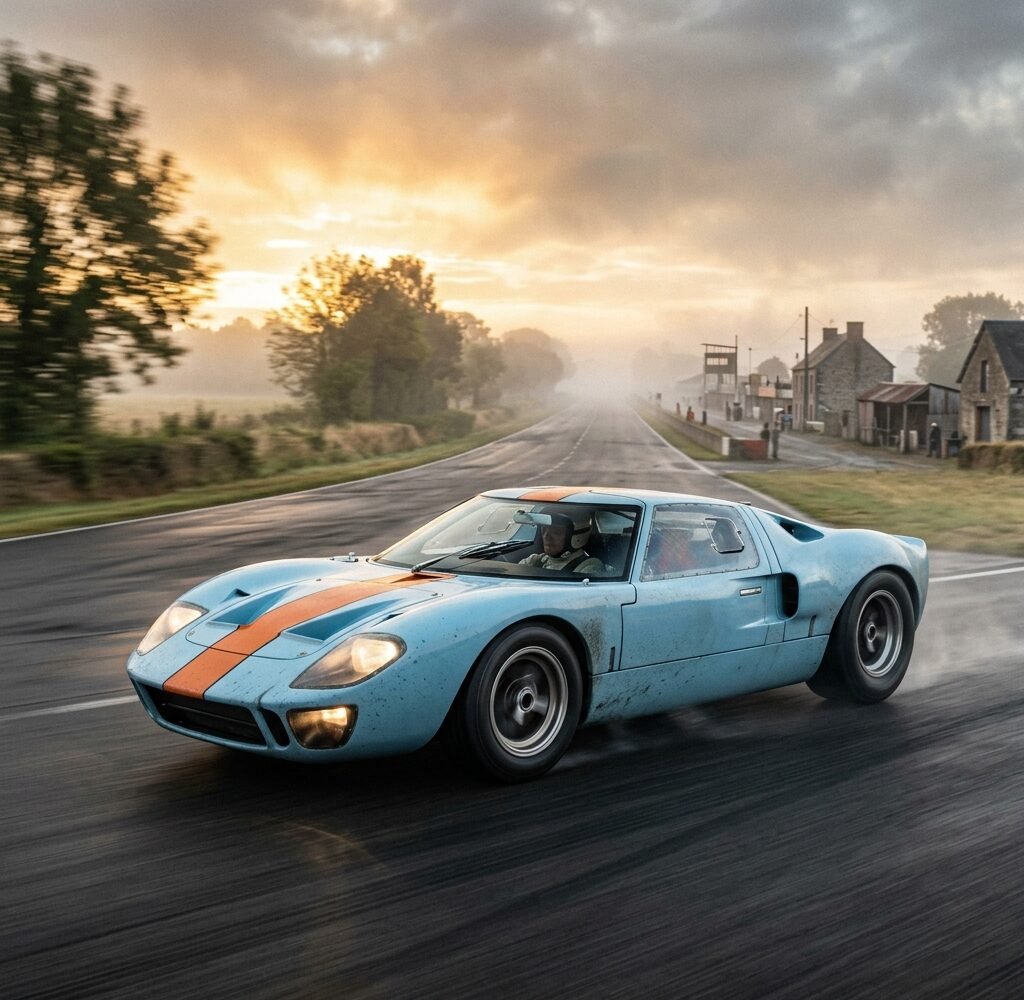
The Ford GT40 Was Built With One Goal: Win
The Ford GT40 was not created primarily as a luxury road car.
It was developed to win major international sports-car races.
And the target that mattered most was the 24 Hours of Le Mans.
During the 1960s, European manufacturers dominated many of the world’s most prestigious endurance races.
Ford wanted to demonstrate that an American manufacturer could compete at the highest international level.
The GT40 became the answer.
Its development brought together American corporate resources, British engineering expertise, racing specialists and powerful Ford V8 engines.
The result became one of the most recognizable endurance racing cars ever built.
Why Is It Called GT40?
The name contains two important clues.
GT referred to Grand Touring.
The number 40 was associated with the car’s extremely low height of approximately 40 inches.
That low profile was immediately visible.
The cockpit sat close to the ground.
The roof barely reached the waist of an average adult.
The entire vehicle was shaped around aerodynamic efficiency.
Mid-Engine Architecture
Unlike traditional front-engine American performance cars, the GT40 placed its engine behind the driver.
This helped centralize weight.
The layout was already common in top-level racing because engineers understood its handling advantages.
The body wrapped tightly around the mechanical components.
The driver sat far forward compared with many road cars.
Large air openings helped cool the engine and brakes.
Every major design element was influenced by competition.
Ford V8 Power
Different GT40 versions used different Ford V8 engines.
Early cars used smaller displacement units.
Later versions became famous for larger V8s.
The combination of substantial American engine torque and low aerodynamic bodywork created excellent high-speed performance.
At Le Mans, however, outright speed was only part of the challenge.
The car needed to survive.
Engines had to run for hours.
Gearboxes needed to tolerate repeated high-speed operation.
Brakes needed to survive constant deceleration.
Lighting had to work throughout the night.
Drivers needed enough comfort and ventilation to remain focused.
Endurance racing tested the entire automobile.
Why Le Mans Was So Difficult
The 24 Hours of Le Mans combines enormous speed with mechanical endurance.
Cars travel huge distances.
The race continues through daylight and darkness.
Weather can change.
Drivers share the car in shifts.
Mechanical failures that might never appear during a short race can become major problems after many hours.
Winning therefore requires more than producing the fastest qualifying lap.
Reliability becomes performance.
The GT40 program learned this lesson through development and early failures.
Eventually, the engineering matured.
The GT40’s Major Success
The GT40 became famous for winning Le Mans during the second half of the 1960s.
Those victories transformed Ford’s international motorsport reputation.
They also created one of the most powerful stories in American racing history.
A company associated with mass-market cars had successfully developed a machine capable of defeating Europe’s strongest endurance-racing competitors.
Carroll Shelby’s Role
Carroll Shelby and his team became important contributors to the program.
Shelby’s experience with the Cobra and American V8 performance helped improve the GT40.
Development involved extensive testing.
Problems with aerodynamics, brakes, transmissions and reliability had to be solved systematically.
This is an important part of the story.
The GT40 was not instantly successful.
Its reputation came from engineering persistence.
What Was It Like to Drive?
The cockpit was extremely compact.
Drivers sat low with the engine directly behind them.
Visibility was limited compared with ordinary road cars.
Heat and noise were significant.
At high speeds, stability was essential.
Steering inputs needed precision.
During endurance races, drivers had to maintain concentration for long periods while managing traffic containing different classes of cars.
The GT40 demanded physical and mental endurance.
Road Versions
Although fundamentally a competition machine, road-going versions were also produced.
These cars are exceptionally desirable today because they combine racing architecture with road legality.
However, even road examples retain much of the racing car’s character.
Entry can be awkward.
Cabin space is limited.
Cooling and visibility reflect motorsport priorities rather than luxury-car priorities.
Why the GT40 Matters Today
The GT40 changed perceptions about American motorsport engineering.
It proved that American power could be combined with sophisticated chassis design and aerodynamics to succeed in European endurance racing.
It also demonstrated the value of international engineering collaboration.
The GT40 was not simply “an American V8 in a race car.”
It was a sophisticated program involving continuous testing and development.
Its Le Mans success transformed the car into something larger than a machine.
It became a symbol of competition, engineering ambition and persistence.
FAQ
Why is the Ford GT40 called GT40?
The number 40 refers to the car’s exceptionally low height of approximately 40 inches.
Did the Ford GT40 win Le Mans?
Yes. The GT40 achieved multiple victories at the 24 Hours of Le Mans during the 1960s.
Where is the GT40 engine located?
The Ford V8 is mounted behind the driver in a mid-engine configuration.
Was the GT40 a road car?
It was developed primarily for racing, although limited road-going examples were produced.