Chevrolet Corvette C1: How America Created Its First True Sports Car Icon
September 24, 2026 · Oldygoldy
Chevrolet Corvette C1: The Beginning of an American Legend
The Chevrolet Corvette C1 occupies a unique position in American automotive history.
When Chevrolet introduced the Corvette in the early 1950s, American roads were dominated by large sedans, coupes and convertibles. European manufacturers such as Jaguar, MG and Porsche were attracting growing attention from drivers who wanted smaller, more exciting sports cars.
Chevrolet saw an opportunity.
The result was the Corvette, a low two-seat roadster that would eventually become one of the longest-running sports-car nameplates in the world.
But the first Corvette was not immediately the powerful performance machine that enthusiasts imagine today.
Its development involved experimentation, mechanical changes and several important improvements.
Why Chevrolet Built the Corvette
After World War II, American drivers became increasingly interested in European sports cars.
Returning servicemen had encountered vehicles from Britain, Italy and Germany that were very different from typical American automobiles.
These cars were smaller, lighter and designed around the driving experience.
Chevrolet wanted to create an American alternative.
The company developed a two-seat roadster with dramatic styling and an innovative body material.
Instead of conventional stamped steel panels, the Corvette used fiberglass bodywork.
This reduced tooling requirements for the relatively low-volume car and allowed designers to create shapes that would have been expensive to manufacture using traditional methods.
The Early Corvette Engine
The earliest Corvettes did not use the large V8 engines that later became closely associated with the model.
Instead, they were powered by Chevrolet’s inline six-cylinder engine.
Performance was respectable for the period, but it was not enough to establish the Corvette as a serious competitor to the best European sports cars.
The situation changed when Chevrolet introduced its small-block V8.
The lightweight V8 transformed the Corvette.
Suddenly the car had the power necessary to support its aggressive appearance.
Over the following years, Chevrolet continued improving engine output, transmission choices, suspension behavior and overall performance.
The Importance of the Small-Block V8
The Chevrolet small-block V8 became one of the most influential American engines ever produced.
It was compact, relatively lightweight and capable of substantial performance.
When installed in the Corvette, it helped redefine the car’s personality.
The Corvette was no longer simply an attractive roadster.
It became a genuine American performance automobile.
Engine options evolved quickly.
Buyers could choose increasingly powerful configurations, and fuel injection eventually became available on certain versions.
For the late 1950s, fuel injection was sophisticated technology.
This helped Chevrolet market the Corvette as more than a stylish cruiser.
Corvette Styling Evolution
The C1 Corvette changed considerably during its production life.
Early cars featured relatively simple rounded bodywork.
As the decade progressed, the design became more dramatic.
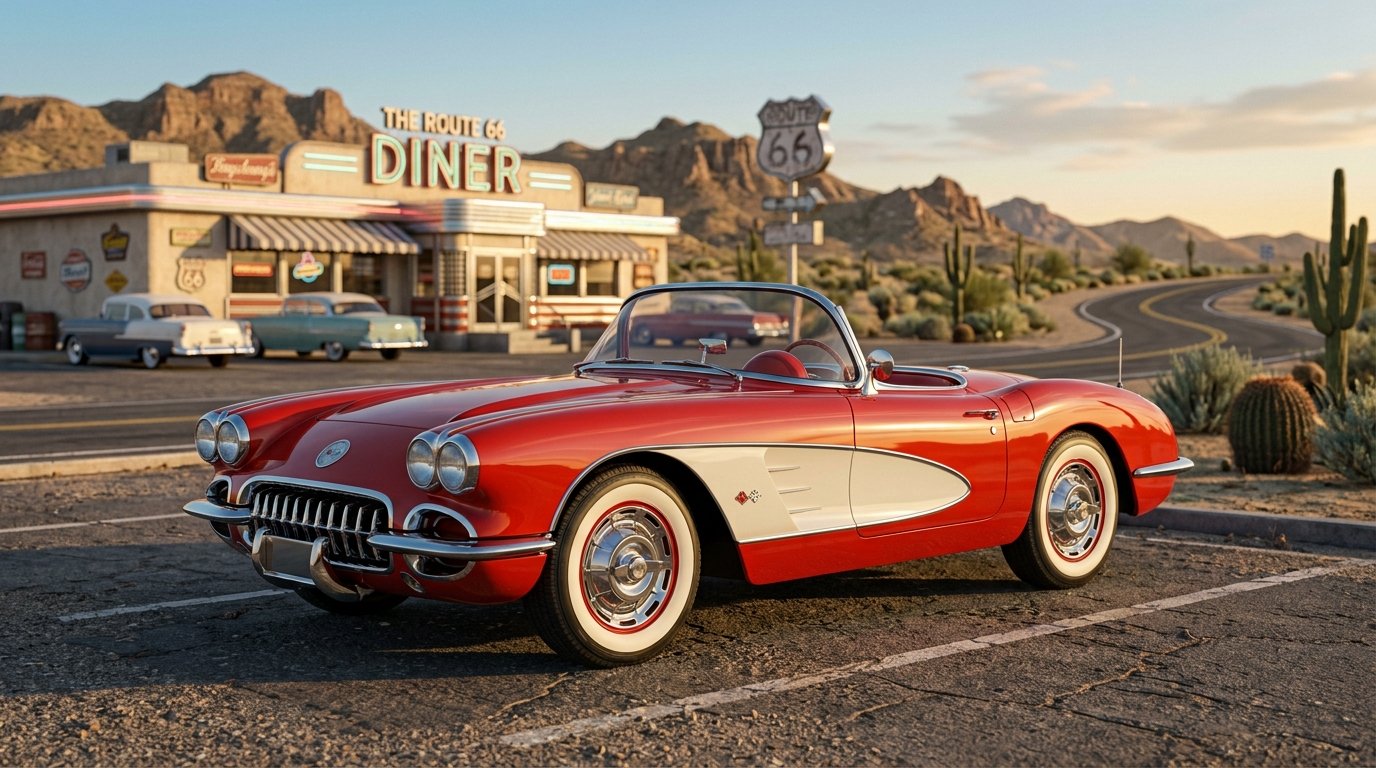
A revised front end introduced four headlights.
Chrome trim became more elaborate.
Body-side coves became one of the Corvette’s most recognizable design elements.
These contrasting areas along the sides gave the car a distinctive visual identity.
By the early 1960s, the Corvette looked significantly more mature and purposeful than the original 1953 version.
The later C1 cars also previewed styling elements that would influence the next generation.
Was the C1 Corvette a Real Sports Car?
This question has generated debate among enthusiasts.
Compared with lightweight European sports cars, the early Corvette was relatively heavy and mechanically conventional.
But the definition of a sports car was evolving.
Chevrolet created something uniquely American.
Instead of copying European manufacturers exactly, the Corvette combined roadster styling with American engine power.
As development continued, its performance became increasingly serious.
The Corvette also entered competition, helping demonstrate that it could perform beyond ordinary street use.
What Is a C1 Corvette Like to Drive?
Driving a C1 Corvette is dramatically different from driving a modern Corvette.
There are no electronic stability systems.
Steering effort can be significantly higher.
Brakes require more anticipation.
The chassis moves more noticeably over imperfect roads.
But these limitations create involvement.
The driver feels the engine, suspension and road conditions directly.
A V8-powered Corvette also delivers one of the defining characteristics of American classic cars: strong low-speed torque accompanied by a distinctive exhaust sound.
The experience is mechanical rather than digital.
What Should Buyers Check?
Anyone considering a C1 should inspect the car carefully.
Fiberglass does not rust like steel, but the structure underneath still requires inspection.
Previous collision repairs may be difficult to identify if bodywork was poorly restored.
Panel fit, paint quality and chassis condition should all be examined.
Engine originality can also influence collector value.
Some buyers prioritize matching-number cars.
Others prefer upgraded vehicles that are easier to drive.
Neither approach is automatically correct.
The important point is understanding exactly what you are buying.
Why the Corvette C1 Matters Today
The C1 established the foundation for every Corvette that followed.
The formula became clear: two seats, dramatic styling, strong performance and an unmistakably American personality.
Later Corvettes became much faster and more sophisticated.
But without the C1, none of them would exist.
The original Corvette also proved that an American manufacturer could create a long-term sports-car brand rather than a short-lived experiment.
That makes the first-generation Corvette much more than a collectible car.
It is one of the most important chapters in American performance-car history.
FAQ
What does C1 mean on a Corvette?
C1 refers to the first generation of Chevrolet Corvette.
Did the first Corvette have a V8?
No. The earliest Corvette used an inline six-cylinder engine before V8 power became available.
Why was the Corvette body made from fiberglass?
Fiberglass allowed Chevrolet to produce the low-volume sports car without the expensive tooling required for large steel body panels.
Is a C1 Corvette a good classic car?
Well-maintained examples are highly desirable, but buyers should inspect chassis condition, fiberglass repairs, mechanical components and restoration quality.
Internal Linking
Connect this article to Jaguar XK120, Porsche 356 Speedster, Shelby Cobra, and your general Classic Car Checklist article.