Porsche 356 Speedster: The Lightweight Sports Car That Built Porsche’s American Legend
September 18, 2026 · Oldygoldy
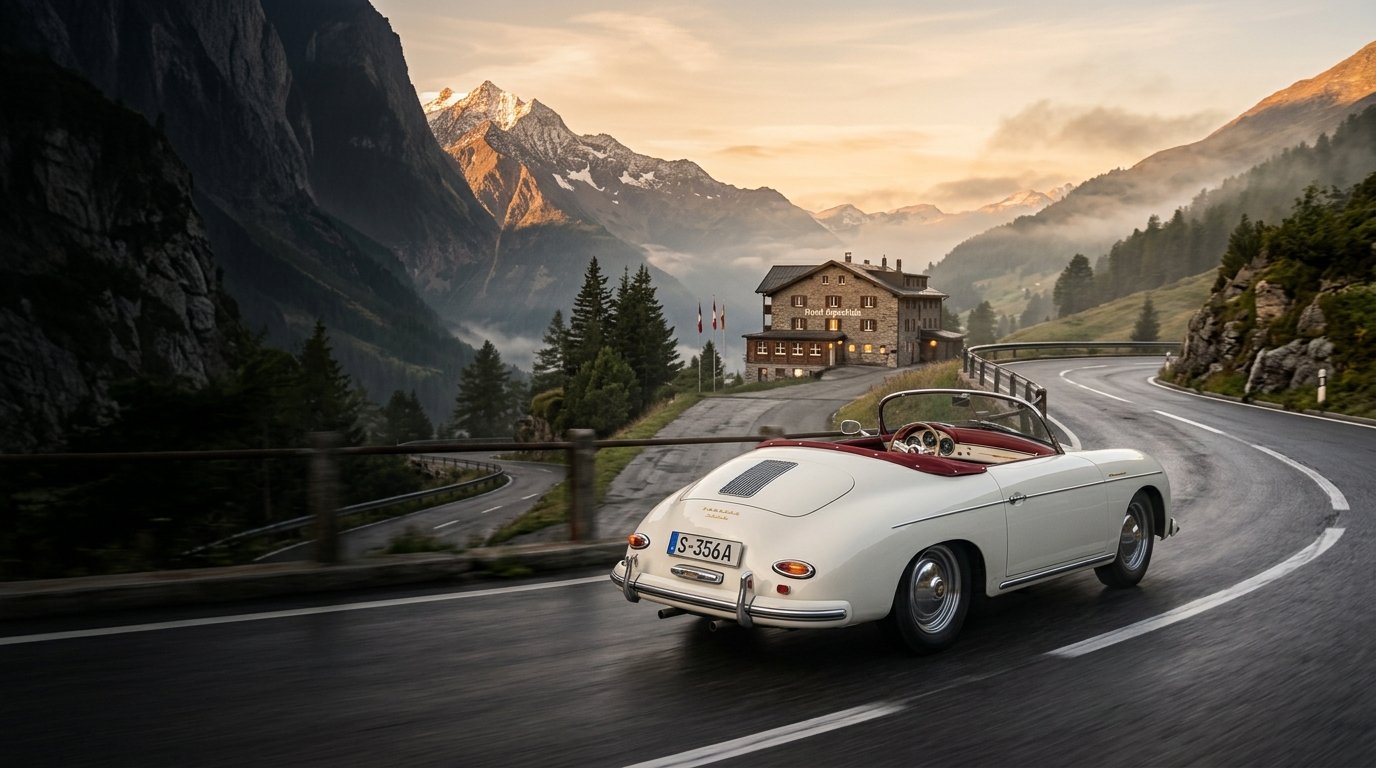
Porsche 356 Speedster: The Simple Sports Car That Became a Legend
The Porsche 356 Speedster is one of the most recognizable sports cars of the 1950s, yet its appeal came from simplicity rather than extravagance. It was small, lightweight, mechanically straightforward and designed around the idea that driving pleasure did not require enormous horsepower.
Today the 356 Speedster is associated with elegant European roads, historic racing and some of the most desirable early Porsche automobiles. But the Speedster itself was strongly connected to the American market.
Before Porsche became famous for the 911, the company built its reputation around the 356.
The first Porsche 356 models appeared shortly after World War II. Early cars established the basic formula that would define Porsche road cars for decades: lightweight construction, compact dimensions and an engine positioned at the rear.
Rather than competing with large-displacement American cars through raw horsepower, Porsche focused on balance, handling and efficiency.
The Speedster took that philosophy even further.
Why Was the Porsche 356 Speedster Created?
The idea behind the Speedster was closely connected to the United States.
American importer Max Hoffman believed Porsche needed a less expensive, stripped-down sports car that would appeal to young American enthusiasts, particularly drivers interested in weekend racing.
The solution was the Speedster.
Compared with more luxurious 356 versions, the Speedster featured a lower removable windshield, simpler interior, lightweight bucket seats and minimal equipment.
These changes reduced cost while simultaneously making the car feel more focused.
Instead of weakening the 356, the simplicity gave it a distinctive identity.
What began as a relatively economical model eventually became one of the most famous Porsche variants ever built.
The Porsche 356 Speedster Engine
The 356 used an air-cooled flat-four engine mounted behind the rear axle.
Different versions of the Speedster were offered with different engine specifications over the production period.
Displacements and power outputs varied, but even more powerful versions remained modest by modern standards.
That is important because the character of the 356 Speedster was never based entirely on horsepower.
Low weight meant the engine did not have to move a massive automobile.
The flat-four engine also contributed to a low center of gravity and helped establish a mechanical layout Porsche would continue developing for generations.
The experience was based on momentum.
Drivers learned to maintain speed through corners rather than relying on enormous acceleration on the straights.
This made the 356 especially rewarding on winding roads.
Why the Low Windshield Matters
One of the easiest ways to recognize a Speedster is its low windshield.
The windshield could be removed for competition, while its reduced height gave the car a lower and more sporting appearance.
The convertible top was also deliberately simple.
These features created a very different personality from the more conventional 356 Cabriolet.
A Speedster appears lower, lighter and more purposeful.
The car seems designed around the driver rather than around luxury.
That minimalist approach would eventually influence many later lightweight sports cars.
The Porsche 356 in American Racing
During the 1950s, sports-car racing was becoming increasingly popular in the United States.
Small European cars were particularly attractive to amateur competitors because they could offer excellent handling without requiring huge engines.
The Porsche 356 became a common sight at club-racing events.
The Speedster was especially well suited to this environment because of its relatively simple specification and low weight.
Drivers could use the same basic automobile on public roads and then compete during the weekend.
This relationship between road driving and motorsport became a fundamental part of Porsche’s reputation.
Decades later, Porsche still markets many of its performance cars around the idea that racing improves road-car engineering.
The 356 helped establish that identity.
Was the 356 Speedster Fast?
By modern standards, even performance versions of the 356 Speedster are not exceptionally fast in a straight line.
But comparing the car only through acceleration numbers misses its purpose.
The 356 was created during a period when roads, tires, brakes and suspension technology were completely different.
Performance came from balance.
A skilled driver could use the lightweight chassis efficiently, carrying speed through corners and taking advantage of the car’s compact size.
That kind of involvement is one reason collectors continue to value early Porsches.
The car asks the driver to participate.
Why Is the Porsche 356 Speedster So Collectible?
Several factors contribute to its desirability.
The Speedster represents an early chapter in Porsche history.
Its styling is instantly recognizable.
Its connection with American sports-car culture gives it historical significance beyond Germany.
It also has a direct visual simplicity that later automobiles rarely achieve.
Another reason is authenticity.
Many replicas and reproduction Speedsters have been built because the design is so popular.
Therefore, collectors carefully examine chassis numbers, engine numbers and documentation when evaluating original cars.
A genuine period 356 Speedster is very different from a modern recreation.
Why the 356 Speedster Still Matters
The Speedster demonstrated that performance did not require excess.
It proved that reducing weight, simplifying equipment and concentrating on driving dynamics could create an automobile more memorable than many cars with much larger engines.
That philosophy remains relevant today.
Modern Porsche models are technologically far more advanced, but many still emphasize steering feel, chassis balance and efficient performance.
The 356 Speedster is therefore not simply a beautiful classic.
It represents one of the clearest early expressions of the Porsche philosophy.
FAQ
What engine does the Porsche 356 Speedster use?
The Porsche 356 Speedster uses a rear-mounted air-cooled flat-four engine, with different displacements and power outputs depending on year and version.
Why was the Porsche 356 Speedster created?
The Speedster was developed as a simpler and less expensive 356 aimed strongly at the American sports-car market.
Is the Porsche 356 Speedster rare?
Original examples are highly collectible, especially because the model has inspired many replicas and recreations.
Why is the 356 important to Porsche history?
The 356 established Porsche’s early reputation for lightweight construction, rear-engine engineering and motorsport-inspired driving dynamics.